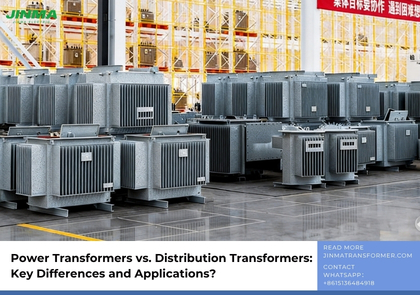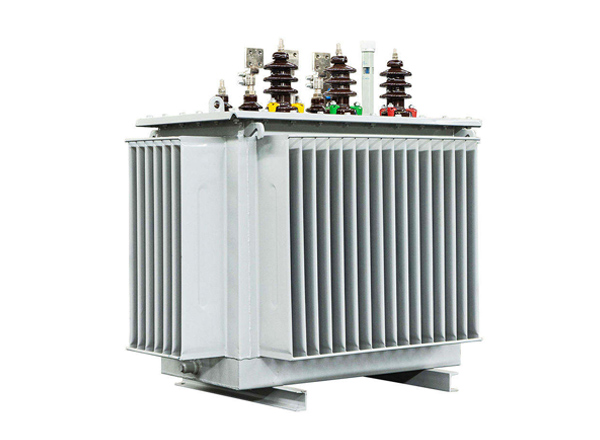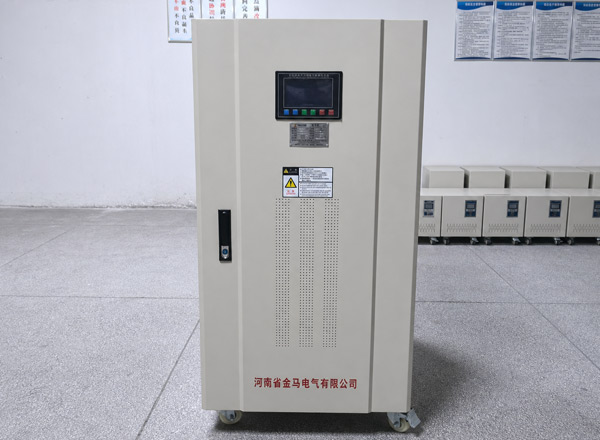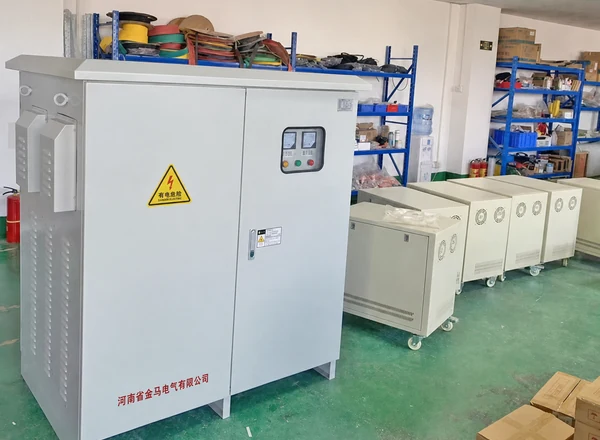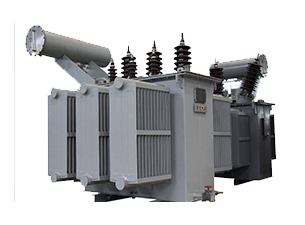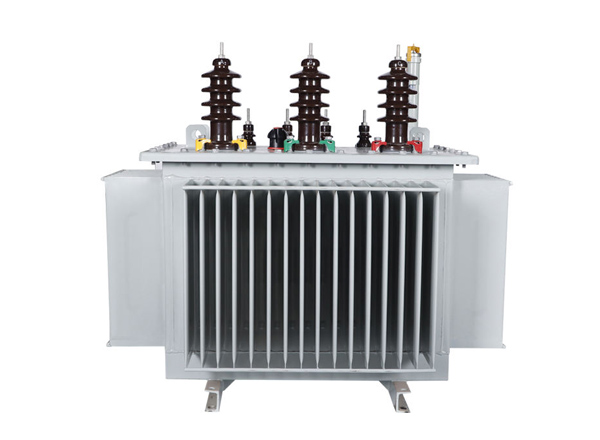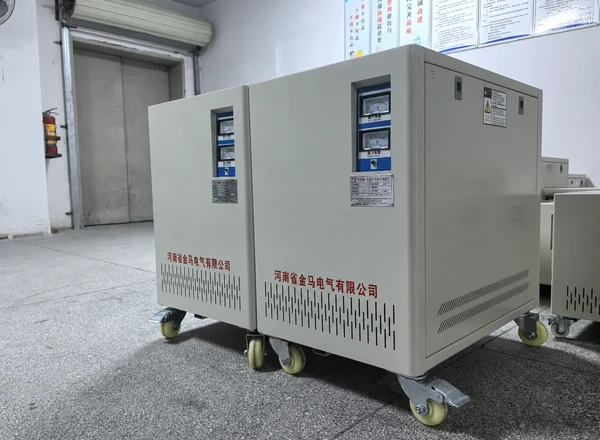


Pad Mounted Transformer, also known as box-type transformer and floor mat transformer, is the core equipment of modern underground power distribution system. It is different from the traditional pole transformer, the use of floor-mounted concrete base installation mode, with high security, concealment and aesthetics, has become the mainstream choice of urban power distribution, commercial and residential support, new energy projects. This article is the latest version of the 2026 pad mounted transformer procurement guide, comprehensive coverage of basic cognition, working principle, product classification, selection parameters, load calculation, industry standards, installation specifications, transformer quotation, transformer manufacturer screening and common problems.
What Is A Pad Mounted Transformer ? Definition And Advantages
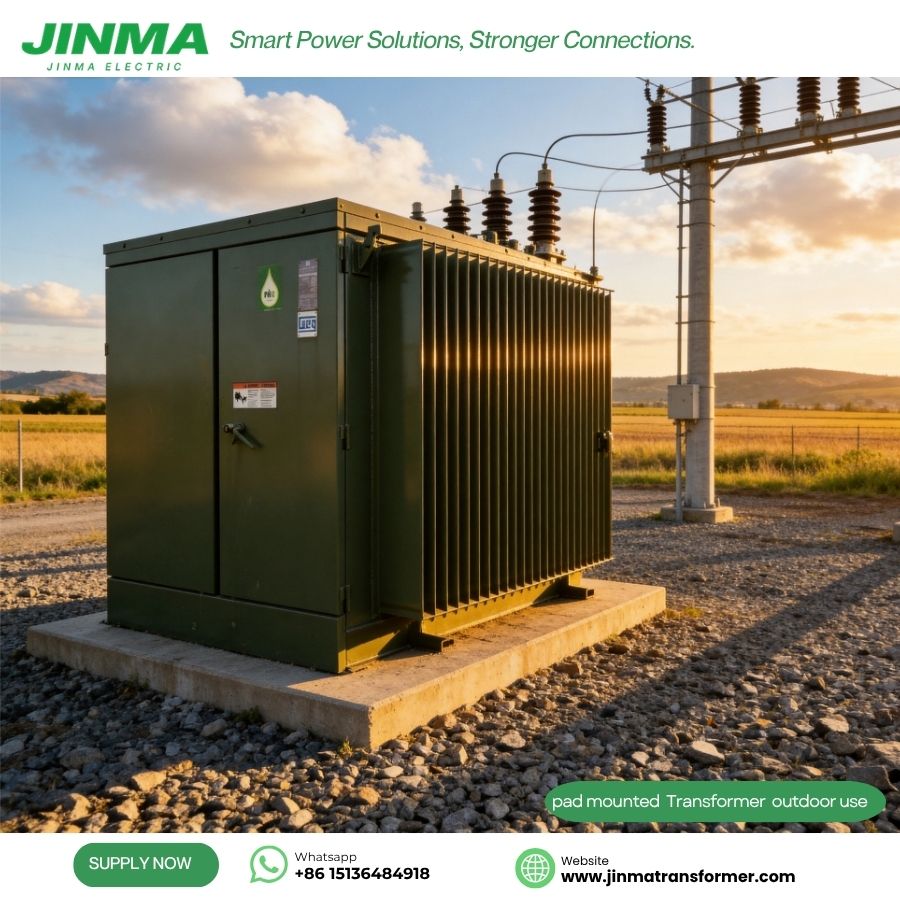
Pad mounted transformer is the a kind of floor installation, closed distribution transformer, the whole fixed on the precast concrete base. The outside of the equipment adopts anti-theft locking steel cabinet, which has the ability of anti-damage, anti-electric shock and all-weather protection. It can be directly deployed in public areas without additional fence protection.
The core function of the floor mat transformer is voltage conversion, which can reduce the voltage of the power grid from 4-35kV to the low voltage available to the terminal equipment. Civil residential buildings commonly use 120/240V voltage specifications, commercial and industrial scenes mostly use 208/120V, 480/277V and other specifications to adapt to different power load requirements.
Most box-type transformers are of fully sealed oil-immersed construction, with all live parts completely enclosed in a grounded metal housing. The industry mainstream uses a front-end safety structure (Dead-Front) without exposed charged bodies to avoid the risk of electric shock in public areas from the root.
Core advantages of pad mounted transformer
The core advantages of pad mounted transformers focus on the four dimensions of safety, adaptation, operation and maintenance, and appearance.
- Outstanding safety performance.The floor mat transformer cabinet is grounded and locked, with no exposed live parts, tamper-resistant and anti-miscontact. It can be directly installed in public areas such as residential areas, parks, streets, etc., without the need to erect protective fences, and conforms to the public electricity safety regulations.
- Adapt to underground power distribution system.The equipment is equipped with underground cable wiring to avoid the problem that overhead lines are easily damaged by rainstorm, typhoon and snow, greatly improve the stability of power supply, beautify the city appearance at the same time, and eliminate the problem of clutter of overhead cables.
- Compact structure does not occupy.The equipment adopts low-profile integrated design, small size, floor-to-floor installation without poles, suitable for urban dense construction areas, park green belts and other narrow installation scenarios.
- Convenient and efficient operation and maintenance. Equipment installation on the ground, operation and maintenance personnel can complete the detection, maintenance, replacement of accessories and other operations on the ground, without high-altitude operations, greatly reducing the difficulty of operation and maintenance and operational risks.
Where Are Pad Mounted Transformer Used For ?
The pad mounted transformer is specially designed for underground power distribution system, with strong scene adaptability, covering civil, commercial, industrial, public facilities and new energy fields.
- Pad mounted transformerfor residential areas. The underground power distribution mode is generally used for ground mat transformers used in new residential quarters and contiguous residential development zones. A single device can serve multiple households, taking into account safety and beauty, is a modern residential power distribution standard equipment.
- Pad mounted transformerfor commercial buildings. Shopping malls, office buildings, industrial parks, commercial and residential complexes and other scenes require high power supply stability and site aesthetics. Box-type transformers used in commercial buildings can perfectly match their all-weather, high-load electricity demand.
- Pad mounted transformerfor public and industrial scenarios. Schools, hospitals, university campuses and other public facilities, as well as factories, warehouses, and light industrial parks, will purchase pad mounted transformer s in batches to ensure continuous and stable power supply.
- Pad mounted transformerfor new energy areas. Box-type transformer in photovoltaic power station, wind power station to complete the voltage rise and fall and power grid docking. At the same time, the floor mat-type variable pressure station data center, urban municipal infrastructure and other high-standard power distribution scenarios are also widely used.
It should be noted that the pure rural overhead line area is still dominated by pole transformers. Box-type transformers are more suitable for modern and standardized underground power distribution projects.
How Does A Pad Mounted Transformer Work?
Working principle of pad mounted transformer
The core working principle of pad mounted transformer is the same as that of all power transformers. The voltage conversion is completed based on Faraday’s law of electromagnetic induction, and the whole process is passive magnetic transmission without manual control.
The medium-voltage electric energy enters the high-voltage cavity from the bottom of the equipment through the underground cable. After the current flows through the primary winding, an alternating magnetic field is generated in the silicon steel laminated iron core. The alternating magnetic field will induce low-voltage electric energy on the secondary winding to realize high-low voltage conversion.
The voltage conversion ratio strictly follows the turns ratio formula: Vp/Vs = Np/Ns. The primary winding has many turns and high voltage, while the secondary winding has few turns and low voltage. Through precise turns ratio, the output meets the standard low voltage required by the terminal equipment.
The entire power transmission process is magnetically coupled transmission, and there is no direct electrical connection on the primary and secondary sides, which can effectively isolate grid-side faults, protect terminal electrical equipment, and ensure a constant power supply frequency with only a small amount of energy loss.
Composition structure of floor mat transformer
The pad mounted transformer adopts an integrated sealing structure, the internal components have a clear division of labor, taking into account the multiple functions of insulation, heat dissipation, protection and power distribution to ensure the long-term stable operation of the equipment.
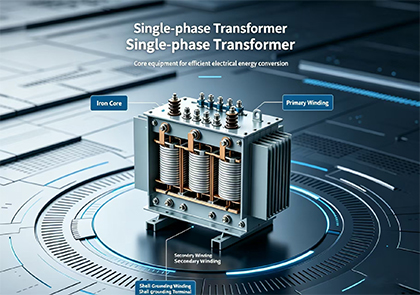
The sealed oil-immersed oil tank is the core component of the floor mat transformer. The core and the winding are immersed in the insulating medium, and the commonly used medium is mineral oil, FR3 natural ester, etc. Insulating oil has the three functions of insulation, heat dissipation and arc extinguishing, and the heat dissipation of the equipment is completed through natural convection, and the corrugated structure of the oil tank can accelerate the heat dissipation.
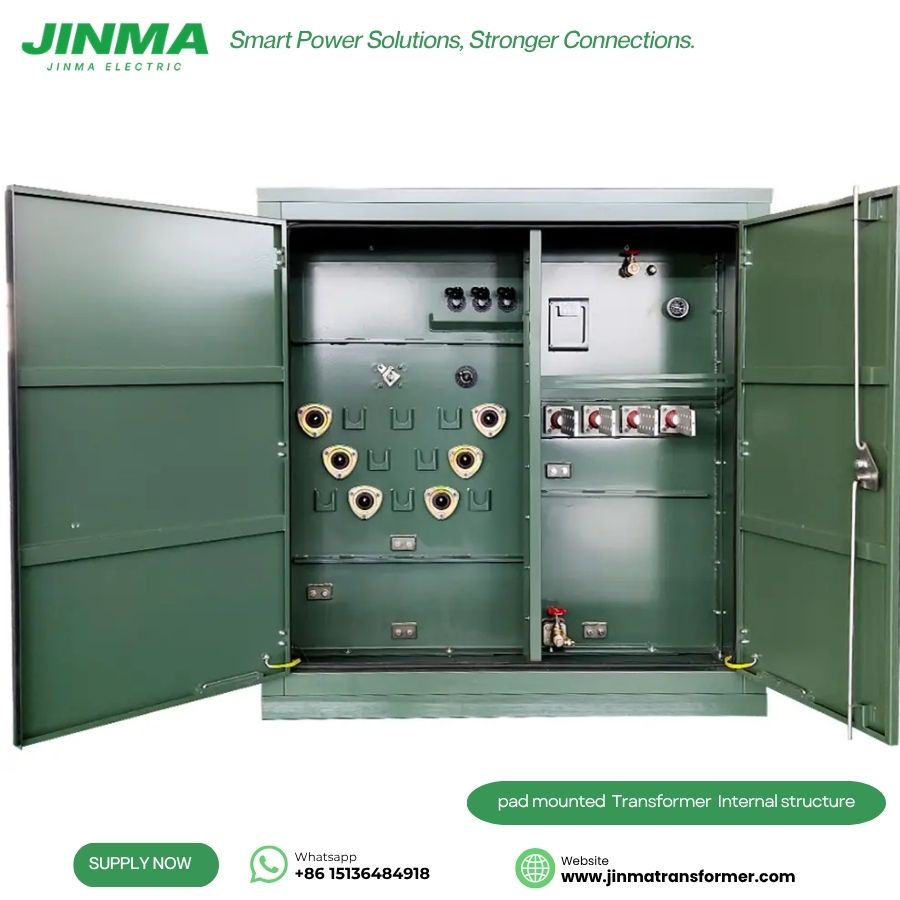
Isolated double chamber cabinet design. The equipment is equipped with physical isolation baffle, which is divided into two independent cavities. The left side is a high-voltage cavity, which integrates high-voltage bushing, bayonet fuse, load switch and other core high-voltage accessories; the right side is a low-voltage cavity, which is equipped with low-voltage connection terminals for terminal cable connection.
Full set of safety protection devices. The equipment comes standard with pressure release device, surge protector and multi-level fuse, which can accurately deal with equipment overload, line short circuit, internal fault and other problems, cut off the power supply in time, and avoid safety accidents such as equipment burning and fire.
Common Types and Applications of Pad Mounted Transformers
Box transformers are mainly classified according to the two dimensions of insulation cooling mode and electrical phase, and different types of equipment differ significantly in cost, performance and adaptation scenarios, which is the core basis for procurement selection.
Oil-immersed pad mounted transformer
Oil-immersed floor mat transformer is the first choice for outdoor floor power distribution. The core winding is completely immersed in insulating oil, and it adopts natural oil circulation and natural air heat dissipation (ONAN) mode, with excellent heat dissipation efficiency.
The equipment has a wide range of adaptation capacity, covering 15kVA-5000kVA and above specifications, stable operation, strong overload capacity, service life of 25-40 years, and extremely high comprehensive cost performance.
Flexible choice of insulation medium, conventional scenes using economical mineral oil; environmental protection, water, building-intensive scenes, can choose flame retardant, biodegradable FR3 natural ester insulating oil, fire safety is higher.
The only short board of this type of equipment is the risk of minor oil leakage, which requires basic anti-seepage treatment. The overall adaptation of residential areas, commercial clusters, industrial parks, municipal underground power distribution and other outdoor scenes.
Dry-type pad mounted transformer
Dry type floor mat transformer adopts epoxy resin, vacuum impregnated solid insulation material, with air as the heat dissipation medium, without any liquid insulating oil, completely eliminate oil leakage, fire hazards, fire protection and environmental protection performance.
However, the short board of dry-type equipment is obvious, the volume and weight are larger under the same capacity, the manufacturing cost is higher, the heat dissipation and overload performance are weaker than that of oil-immersed equipment, and the capacity is generally limited to less than 2500kVA.
This model is mainly used in harsh scenarios, including food processing plants, tunnels, indoor power distribution rooms, high fire-resistant plants, ecologically sensitive areas and other places where the use of oil is prohibited.
Single-phase pad mounted transformer
The capacity of single-phase pad mounted transformer covers 10-250kVA, the mainstream specification is 25-167kVA, and the low-voltage output standard is 120/240V, which is fully suitable for civil single-phase electricity demand. The equipment is small in size and low in cost, and is mainly used for light load scenarios such as suburban residential areas, street lighting, and small shops. A single equipment can serve multiple household loads.
Three-phase pad mounted transformer
The capacity of three-phase pad mounted transformer covers 75-5000kVA, the mainstream specification of commercial industry is 300-2500kVA, and the low voltage can output three-phase four-wire voltage such as 208Y/120V, 480Y/277V, etc.
The trinomial floor mat transformer is standard equipment for commercial complexes, factories, data centers and large parks,
The equipment can carry three-phase loads such as high-power motors, central air conditioners, production lines, and frequency conversion equipment, with balanced power supply and higher efficiency.
Parameters for Purchasing Pad Mounted Transformers
Procurement selection can not only look at the capacity, need to match the power grid standards, load characteristics, site environment, energy efficiency requirements, the following eight core parameters directly determine the degree of equipment adaptation and operating life.
Rated capacity (kVA)
Capacity is the core parameter of the transformer, which directly determines the maximum power supply capacity of the equipment. If the capacity selection is too small, it will lead to long-term overload of the equipment, overheating trip and accelerated insulation aging. If the selection is too large, it will increase the no-load loss and waste the purchase cost. When selecting floor mat transformer, it is necessary to comprehensively calculate the total load, simultaneous coefficient, peak current and future expansion demand of the equipment. It is recommended to reserve 15%-25% capacity redundancy for conventional projects and more than 30% redundancy for long-term planning projects.
High and low voltage voltage level and wiring mode
The voltage on the high-voltage side must strictly match the local power grid system. Common specifications include 4.16kV, 12.47kV, 13.8kV, 24.94kV, 34.5kV, etc. At the same time, the insulation impulse level (BIL) must be confirmed to ensure the safety of high-voltage insulation.
The voltage on the low voltage side shall be fully adapted to the terminal electrical equipment, with priority being 120/240V for civil use and 208Y/120V and 480Y/277V for commercial industry, so as to prevent the equipment from failing to operate normally due to voltage mismatch.
Tap-changer can be selected as required to support ± 2 × 2.5% voltage fine adjustment, which can effectively cope with grid voltage fluctuation and ensure terminal voltage stability.
Operating frequency
The global mainstream is divided into 50Hz and 60Hz, and the equipment frequency must be completely matched with the local power grid. The frequency is not up to standard will lead to abnormal core magnetic flux, soaring loss, equipment heating serious, greatly shorten the service life.
Energy Efficiency Rating and Loss Parameters
Transformer service life for decades, no-load loss, load loss is a core component of long-term operating costs. High-efficiency equipment that meets U.S. DOE energy efficiency standards and industry IEEE standards is preferred when purchasing.
High-quality equipment adopts high-permeability magnetic silicon steel core, optimized winding structure, 40%-60% load range energy efficiency is optimal, can continue to reduce long-term electricity loss, improve the overall economy of the project.
Selection of insulation cooling medium
Mineral oil-immersed equipment is preferred for ordinary outdoor scenes, with high cost performance, mature technology and stable heat dissipation. For water, high-density buildings, and environmental protection control areas, FR3 natural ester insulating oil is preferred, with higher fire rating, biodegradable, safe and environmentally friendly. Indoor, tunnel, high fire requirements of the scene, prohibit the use of oil-immersed equipment, the need to choose a dry transformer, completely avoid fire safety hazards.
Calculation Method of Pad Mounted Transformer Capacity
Accurate calculation of capacity is the core link of selection, which can effectively avoid the problem of small horse-drawn carts and overuse. The following is a general standardized calculation process for the project, which is suitable for residential, commercial and industrial scenarios.
Basic calculation formula
Single-phase transformer capacity: kVA = V×I÷ 1000
Three-phase transformer capacity: kVA = √ 3 ×V×I÷ 1000
Calculation steps
The first step is to count the total connection load. Summarize the rated power of all electrical equipment of the project, including lighting, air conditioning, motor, charging pile, office equipment, etc., and convert them into kW or kVA units.
The second step is to include the simultaneous factor (demand factor). All equipment will not operate at full load at the same time. It needs to be converted according to the scenario: residential 0.4-0.6, commercial 0.6-0.8, industrial 0.7-0.9, data center and other continuous load 0.9 or more.
The third step, power factor conversion. According to the load type matching power factor, conventional commercial load 0.85, lighting UPS load 0.95, motor heavy load 0.8 and below, the active power will be converted into apparent power.
The fourth step, superposition expansion redundancy. Conventional projects increase by 15%-25% future load growth margin, new energy, charging pile expansion projects need to increase by more than 30% margin.
The fifth step is the correction of the capacity reduction under special conditions. In the scenarios of high altitude, high temperature environment, harmonic load and frequent motor starting, the capacity shall be appropriately enlarged to offset the effective capacity attenuation caused by working conditions.
The sixth step is to match the standard capacity specifications. After the calculation is completed, the industry standard capacity level is taken upward, and downward selection is prohibited to ensure the long-term stable operation of the equipment.
Practical Calculation Case (Commercial Three-phase Project)
A commercial building has a total connection load of 400kW, a demand coefficient of 0.75, a power factor of 0.85, and a 20% expansion allowance.
Actual load after conversion = 400kW × 0.75 = 300kW
Basic capacity = 300kW ÷ 0.85 ≈ 353kVA
Capacity with expansion allowance = 353kVA × 1.2 ≈ 424kVA
Upward matching industry standard specifications, the final selection of 500kVA three-phase box-type transformer.
Pad Mounted Transformer Installation Tips To Note
High-quality equipment needs to be installed with specifications, and the installation quality directly determines the safety and service life of the equipment. All construction is to be in accordance with manufacturer’s manuals, NEC codes, IEEE standards and local grid requirements.
Site selection requirements
Priority should be given to areas with flat terrain, smooth drainage and stable foundation to avoid low-lying areas with accumulated water, soft soil and high incidence of flood and waterlogging, and to prevent equipment settlement and water soaking failure.
The installation position of the equipment shall be far away from doors and windows, fire exits, equipment vents, inflammable and explosive materials, and shall not block the passage of personnel and vehicles.
Reserve sufficient operation and maintenance operation space to ensure that later maintenance, equipment replacement and emergency operations can be carried out normally. The area with dense traffic flow shall be equipped with anti-collision guardrail to avoid equipment impact damage.
Construction standard of concrete foundation
The base shall be horizontal and flat, and the inclination shall be strictly controlled within the specification range, so as to avoid the deviation of the internal iron core and winding caused by the inclination of the equipment and the imbalance of the insulating oil level.
The size of the base shall be larger than that of the equipment base, with a margin of not less than 6cm reserved around, and the thickness shall be controlled at 4-8 inches according to the capacity of the equipment. Reinforcement shall be built in to prevent foundation settlement and cracking.
The cable threading pipe shall be reserved at the bottom of the base to meet the design requirements of the bottom line, and ensure the regular wiring and tight sealing.
Safe Spacing and Operating Space
An open area of 8-12 m shall be reserved on the front operating surface of the equipment to meet the requirements of live operation and equipment maintenance.
The side and back of the equipment shall be reserved with a distance of not less than 3 meters to ensure the ventilation and heat dissipation of the equipment and facilitate the maintenance of side cables. The distance between buildings and combustible materials shall match the fire protection code, and the safety distance around combustible walls, doors and windows shall be appropriately increased.
Earthing and electrical construction
Before the equipment is powered on, the cabinet, iron core, neutral point and cable shielding layer must be uniformly grounded, and the grounding resistance must be strictly up to the standard to avoid the risk of electric shock and lightning stroke. Complete wiring in strict accordance with phase sequence and polarity, check the position of tap changer in advance, and prevent equipment failure caused by wiring error. Standard insulated elbow joints are used at the high-voltage end, and all cabinet interfaces are locked and sealed to prevent sundries and rainwater from entering the equipment.
2025-2026 Pad Mounted Transformer Price and Cost
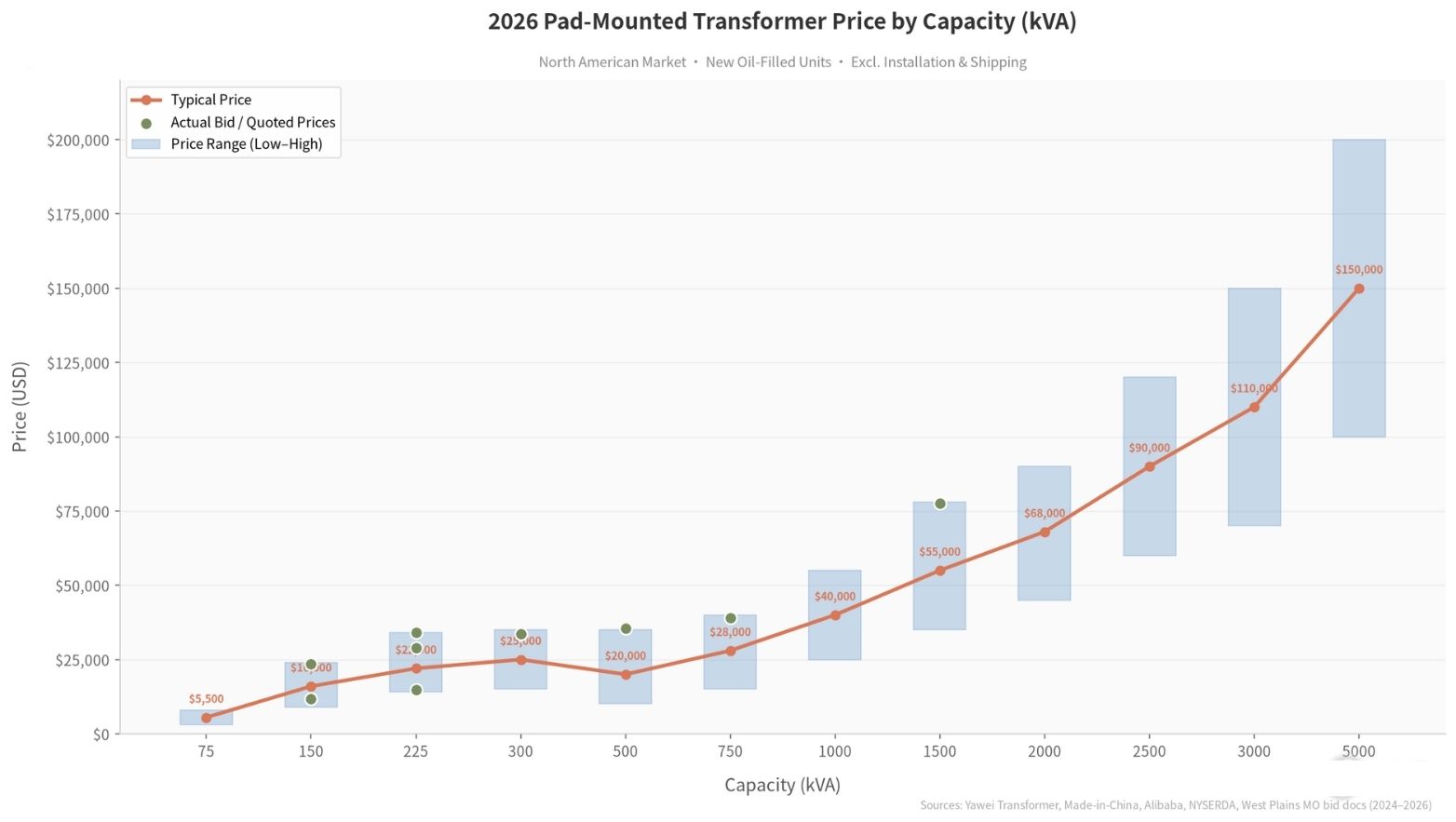
Pad mounted transformer prices by capacity, phase, material, insulation media, configuration, brand and other factors, in recent years by raw materials, supply chain, energy efficiency standards upgrade, the overall market price floating significantly. The following is the latest industry floor mat transformer quotation.
75-150kVA:16000-33000 USD
300kVA: $28000-$47000
500kVA: $38000-$65000
750-1000kVA: $48000-88000
1500kVA: $68000-108000
2500kVA and above: 88000-155000 USD and above
Factors Affecting Transformer Price Fluctuation
Winding material: copper winding equipment price is higher than that of aluminum winding, but the conductive performance, stability and service life are better.
Insulation medium: FR3 natural ester insulating oil configuration, compared to ordinary mineral oil premium 8%-15%.
Customized box transformer: high voltage grade, special BIL parameters, loop feed, intelligent monitoring, stainless steel cabinet and other customized configurations will further increase the price of box transformer.
How to Choose Reliable Pad Mounted Transformer Manufacturers?
Box-type transformers belong to the core power equipment for long-cycle operation, the strength of the manufacturer directly determines product quality, operational stability and after-sales protection, procurement needs to be comprehensively screened from seven dimensions.
Verification of compliance qualifications (hard threshold)
Reliable transformer manufacturers must have complete industry qualifications, products in strict compliance with IEEE, DOE, UL, CSA, ISO9001 quality system standards, can provide a full set of test reports, certification, factory test bench accounts.
Eliminate small manufacturers with no qualification, incomplete qualification and application qualification, and avoid equipment that cannot be connected to the grid and unqualified acceptance.
Inspection of production and testing strength
Reliable pad mounted transformer suppliers have independent core production capacity, can independently complete the core processing, winding, fuel tank welding, vacuum drying, machine assembly and other core processes, do not rely on outsourcing. The manufacturer shall be equipped with a full set of testing equipment such as high voltage test, variable ratio test, loss test, temperature rise test, impact test, etc., and can issue authoritative factory testing reports to ensure that the parameters of each equipment meet the standards.
Verification of industry project experience
Priority is given to transformer manufacturers who have been deeply involved in the industry for many years and have a large number of residential, commercial, industrial and new energy project cases. They are familiar with the grid access standards of various regions and can accurately match the project needs.
Transformer manufacturers may be required to provide similar project cases, user reputation, cooperative power company and engineering resources to verify their supply capacity and product stability.
Evaluate customization capabilities
High-quality floor mat transformer manufacturers have a professional technical team, according to the voltage level, impedance parameters, environmental conditions, feed mode and other needs, to provide personalized customization services, adapt to special project scenarios.
Pre-sales can provide parameter selection, load calculation, scheme optimization support, follow up the production progress in the whole process of sales, provide technical answers after sales, and ensure the landing of the project in the whole process.
Confirm supply chain stability
Power equipment supply chain fluctuations, reliable manufacturers have a stable raw material supply chain and capacity reserves, can provide a clear, landing delivery cycle, to prevent the delay of delivery affect the project schedule.
Procurement pit avoidance red line
Be alert to pad mounted transformer suppliers whose quotations are far lower than the average price of the industry, unable to provide formal qualifications and inspection reports, refusing on-site factory inspection, and imperfect after-sales system, and avoid purchasing inferior equipment at low prices, resulting in high operation and maintenance costs and potential safety hazards in the later period.
FAQ Frequently Asked Questions
Q1: What is the main purpose of pad mounted transformer ?
Mainly used in outdoor underground power distribution system, the power grid voltage voltage step-down for civil, commercial, industrial available low-voltage power, widely serving residential areas, business parks, factories, schools, hospitals, new energy power stations and other scenarios, is the core equipment of modern urban power distribution.
Q2: How to accurately select the transformer kVA capacity?
First, the total electricity load of the project is counted, combined with the simultaneous coefficient and power factor to convert the actual demand capacity, and the 15%-25% expansion margin is superimposed, which is appropriately corrected according to special working conditions, and finally the industry standard capacity specification is selected upward.
Q3: The core difference between box transformer and pole transformer?
Box transformer floor installation, fully enclosed protection, high safety, good aesthetics, suitable for underground power distribution and public areas.
Q4: Are box transformers oil-immersed?
It’s not. Oil-immersed type is the mainstream of the market and is suitable for most outdoor scenes. Dry oil-free equipment is suitable for special scenes with strict fire prevention and environmental protection requirements, and can be flexibly selected according to the working conditions when purchasing.
Q5: How long is the normal service life of pad mounted transformers?
Under the premise of accurate selection, standardized installation and regular operation and maintenance, the service life of high-quality equipment can reach 25-40 years, which is a long life cycle of power fixed assets.
Q6: Inquiry pad mounted transformer need to provide what core parameters?
It is necessary to specify the capacity, phase, high and low voltage voltage level, frequency, insulation medium, feeding mode, installation environment, implementation standard and customization requirements, so as to facilitate manufacturers to accurately quote and customize production.
Conclusion
If you are looking for a customized pad mounted transformer, provide your required capacity, primary/secondary voltage, frequency, phase, and applicable standards to a qualified transformer manufacturer for a suitable solution. Contact Jinma Electric now !