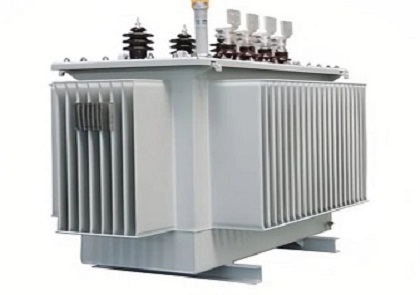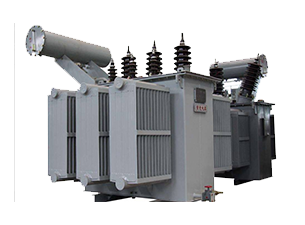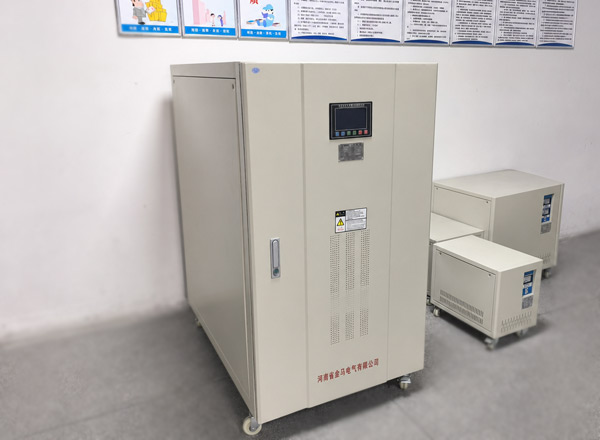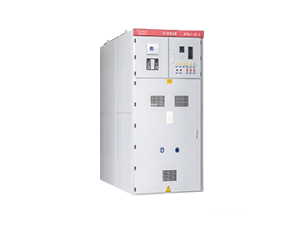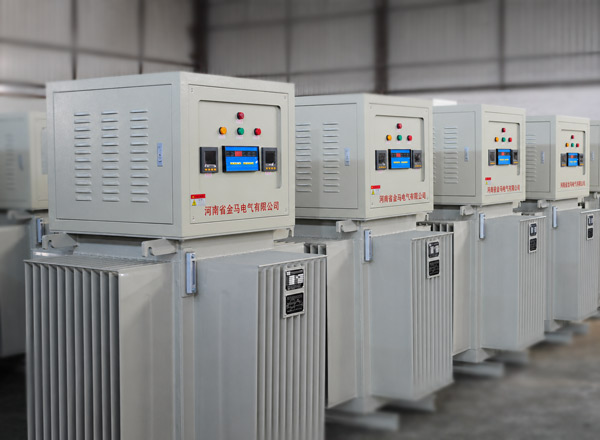


Power pole transformer is also often called pole-mounted transformer and pole-mounted distribution transformer. It is an outdoor oil-immersed power distribution core equipment suitable for overhead transmission lines and suspended on power towers. It is mainly responsible for reducing the high-voltage electric energy in the power grid into low-voltage mains that can be safely used in terminal scenes such as residents, shops and farms. It is a key hub connecting the trunk power grid and terminal power equipment. Pole-mounted distribution transformers are commonly installed on utility poles to reduce medium-voltage electricity to a level suitable for end users. The appropriate transformer rating depends on the connected load, voltage requirements, and local utility specifications.
What Is A Power Pole Transformer?
Power pole transformer is specially designed for outdoor overhead line distribution transformer, the overall use of fully sealed waterproof structure, long-term adaptation to open air, wind and rain, exposure and other complex outdoor conditions. The function of the pole-mounted distribution transformer is to reduce the medium and high voltage power (2.4kV-34.5kV) of the transmission line to 120/240V, 208/480V and other civil and commercial standard low voltage voltages to ensure the safety and stability of terminal electricity. Pole mounted transformers have unique advantages:
- Outstanding cost performance: Compared with box-type transformers, pole transformers do not need to cast concrete foundation, do not need to excavate underground pipelines, and the early installation cost is lower, greatly reducing the project budget.
- Convenient installation and maintenance:lightweight design of equipment, installation, maintenance and replacement can be completed by relying on electric operation vehicles, short construction cycle, extremely low difficulty in later operation and maintenance, and suitable for large-scale popularization and construction.
- Strong environmental adaptability: fully sealed anti-corrosion tank with professional insulation heat dissipation structure, can withstand high temperature, cold, rainstorm, dust and other harsh outdoor environment, adapt to all kinds of urban and rural, rural scenes.
- Flexible and controllable networking: The number of equipment can be flexibly increased or decreased according to the power load of the area, and the capacity of the pole transformercan be adjusted to adapt to different power consumption scenarios such as scattered households, centralized communities and small commercial entities.
How Do Pole Transformers Work?
Electromagnetic Induction Step-Down
The operation core of the pole transformer relies on the classical electromagnetic induction principle, and realizes accurate voltage reduction through the winding turn number difference. The whole process has no mechanical transmission, stable operation, low noise and low failure rate.
The high-voltage alternating current is first connected to the high-voltage winding on the primary side of the transformer. After being energized, a continuously changing alternating magnetic field is generated in the laminated core.
The alternating magnetic field penetrates through the secondary low voltage winding and induces a new low voltage current according to the law of electromagnetic induction. Because the number of secondary winding turns is much less than that of primary winding, accurate voltage reduction is finally realized.
The precise step-down ratio of the equipment is completely determined by the turns ratio of the high and low voltage windings, which is also the core design basis of transformers of different voltage levels and different capacities.
Heat Dissipation And Insulation Mechanism Of Oil-Immersed Seal
Most of the pole mounted transformers on the market are oil-immersed structure, the tank is filled with insulating oil, mainly divided into mineral oil and environmentally degradable ester oil, suitable for different environmental protection requirements of the engineering scene.
Insulating oil has dual core functions: one is to provide high-strength electrical insulation, isolate high and low voltage windings from iron cores, and eliminate potential safety hazards such as leakage, short circuit, breakdown, etc.
The second is to assume the heat dissipation function, relying on the natural convection heat dissipation mode (ONAN), the heat generated by the iron core and winding work is transferred to the surface of the tank and dissipated into the external air.
The equipment adopts fully sealed tank design, some models are equipped with moisture absorption breathing device and temperature compensation structure, which can effectively prevent rain, moisture and impurities from entering the equipment and ensure long-term stable outdoor operation.
Core Components Of Power Pole Transformer
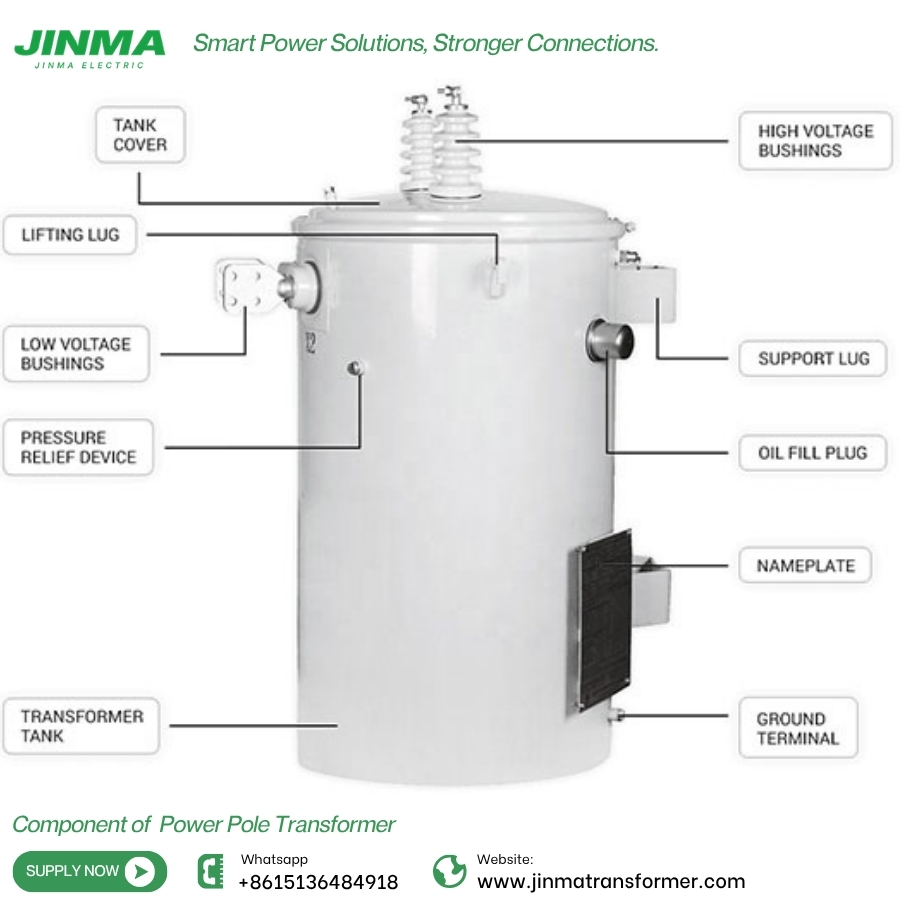
All parts of the pole mounted transformer are designed according to functional modularization, perform their duties and work together to jointly ensure the insulation, heat dissipation, voltage resistance and protection performance of the equipment, and fully meet the outdoor long-term operation standards.
Iron core and winding
The core is the magnetic core of the equipment. It is laminated with high magnetic orientation silicon steel sheets. The layered laminated structure can greatly reduce eddy current loss and hysteresis loss, and reduce heat generation and energy consumption of equipment operation.
High voltage primary winding adopts multi-turn insulated copper wire/aluminum wire winding design, suitable for high voltage input condition of power grid, high insulation grade and strong withstand voltage performance.
Low-voltage secondary winding adopts foil winding technology, with fewer turns, excellent short-circuit resistance and heat dissipation performance, and stable output of standard low-voltage electric energy.
Insulation paper, insulation cardboard and other dielectric isolation are provided between high and low voltage windings and iron cores to completely eliminate internal short circuit and leakage problems and improve the safety and stability of equipment.
Insulation and heat dissipation system
Insulating oil is the core dielectric of oil-immersed transformer, which has high dielectric strength and can wrap the core winding assembly in all directions to construct a complete insulation protection system.
The heat generated by the operation of the equipment is continuously transmitted to the heat dissipation surface of the tank through the natural convection circulation of insulating oil, without additional cooling fans, energy saving, silence and low failure rate.
In view of the oil thermal expansion and contraction caused by temperature change, the equipment is equipped with sealing compensation structure, and some high-end models are equipped with dry respirators to isolate external moisture and prevent oil from moisture and deterioration.
Hermetic tank shell system
The equipment shell is made of thick steel welded into cylindrical or rectangular sealed tank, the whole through anti-corrosion, anti-rust spray treatment, adapt to outdoor complex environment.
Corrugated heat dissipation wall and fins are designed on the surface of the tank to effectively expand the heat dissipation area, improve the natural heat dissipation efficiency, and avoid high temperature overload operation of the equipment.
The whole grounding design of the tank can effectively release static electricity, avoid lightning induced voltage, and comprehensively ensure the safety of equipment and line operation.
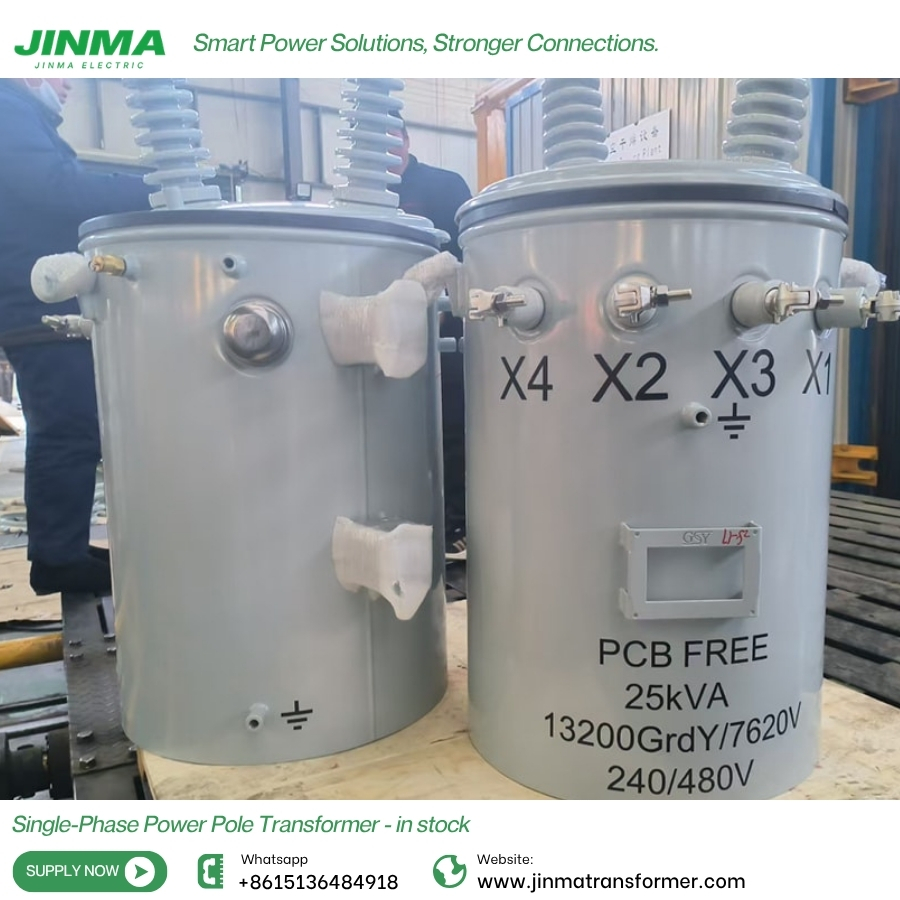
Pole Transformer: Single Phase Vs Three Phase Transformer
According to the power phase, pole transformers are divided into single-phase and three-phase in the industry. The parameters, load capacity and application scenarios of the two are significantly different, and the engineering selection needs to be strictly distinguished.
Single-phase Power Pole Transformer
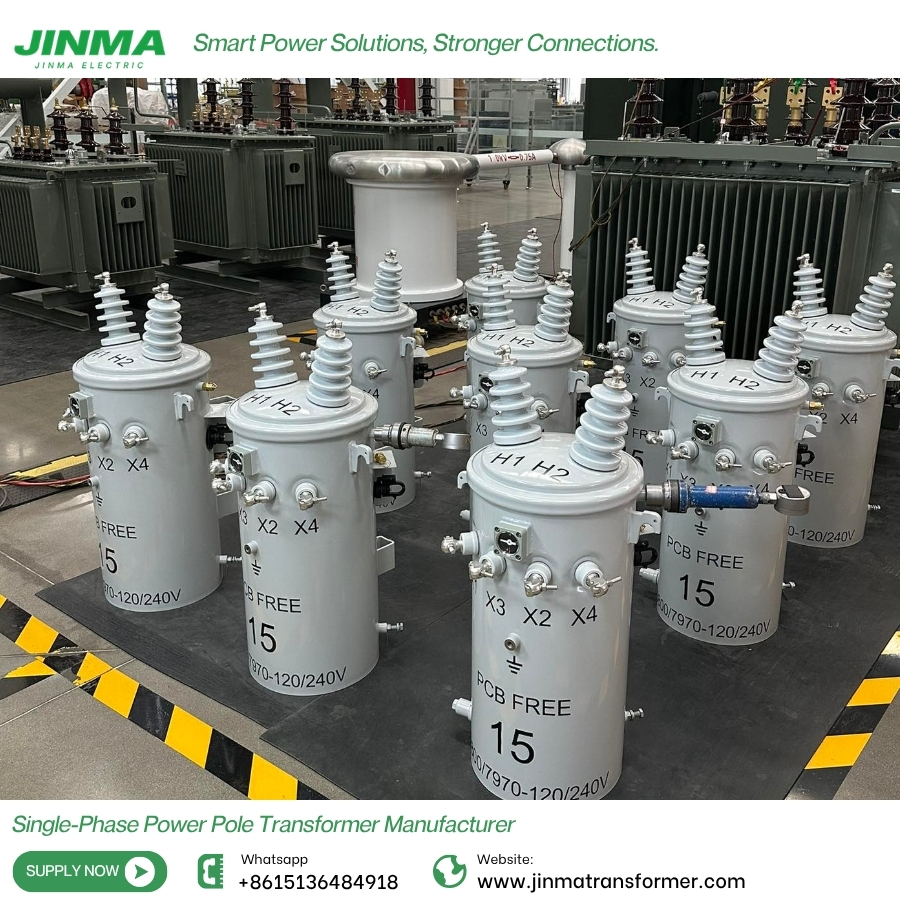
Single-phase transformer is the most mainstream pole-mounted power distribution equipment in civil scenes. It has simple structure, small size and light weight, and is suitable for direct suspension installation of ordinary power towers.
The conventional capacity range is 5 – 167kVA, and the common specifications for civil use are concentrated in 10kVA, 25kVA, 50kVA and 100kVA, which are fully suitable for scattered residential electricity load.
The input high voltage is adapted to 2.4kV-34.5kV overhead lines, the mainstream civil input class is 7.2kV, 12.47kV, 13.8kV, and the output standard 120/240V split phase low voltage.
The core advantage lies in low cost, simple installation and maintenance, low energy consumption, single independent use, but also three groups to form a three-phase power supply system, extremely expandable.
It is mainly used in small and decentralized power consumption scenarios such as single-family houses, rural retail households, small households in urban suburbs, street lighting, etc.
Three-phase Power Pole Transformer
Three-phase transformer is a special equipment for high power load, which integrates three groups of windings and multi-column iron core. Its structure is relatively complex, and its power supply balance and load carrying capacity far exceed single-phase equipment.
The conventional capacity range is 15 – 500kVA, and the weight of large-capacity equipment above 300kVA is relatively large. Generally, it needs to be installed with tower platform and cannot be directly suspended.
The main output voltage specifications are 208Y/120V and 480Y/277V, which can meet the operation requirements of high-power equipment such as three-phase motors, HVAC equipment and small processing equipment.
Three-phase pole-mounted transformer has high power supply efficiency, good power quality and low line loss, which is suitable for long-term stable high-power balanced load power supply scenarios.
It is mainly used in small shops, multi-storey apartments, large farm equipment, light industrial plants, township public infrastructure and other scenarios.
Comparison Of Core Pole Transformer Specifications
Capacity level: single-phase 5 – 167kVA, suitable for small loads; three-phase 15 – 500kVA, suitable for medium and large loads. Voltage output: single-phase to 120/240V civil voltage-based, three-phase to 208Y/120V, 480Y/277V industrial commercial voltage-based.
Cost and construction: single-phase structure is simple, low cost, convenient installation; three-phase higher cost, higher construction requirements.
Scenario adaptation: single-phase specializing in civilian scattered load, three-phase specializing in commercial, agricultural, light industrial balanced load.
Pole-Mounted Transformer Vs Pad-Mounted Transformer: What Is The Difference?
The pole mounted transformer and the pad-mounted transformer are the two mainstream equipment of the power distribution system, the core function is the same, but the installation form, cost, safety, adaptation scene is very different, the project selection needs to be accurately distinguished.
Differences of transformer installation
The utility pole transformer is suspended and installed on the power pole tower, relying on the overhead line network, without the need for ground space, and is the exclusive equipment of the overhead power distribution system.
The pad-mounted transformer is installed on the ground concrete base, supporting the underground cable wiring, occupying the ground space, and is mainly adapted to the urban underground distribution network system.
Detailed comparison of multi-dimensional specifications
Cost construction: the transformer on the pole does not need civil pouring, pipeline excavation, low installation cost, short duration.
- Space occupation: the equipment on the pole only occupies the tower space, and there is no ground occupation. Buried equipment needs special installation area and safety protection distance.
- Safety and protection: wire pole mountedtransformer is installed in the air to avoid the risk of human touch, but it is easily affected by wind and rain, lightning and trees. Buried equipment is fully enclosed and locked, with stronger anti-damage and weather resistance.
- Difficulty in operation and maintenance: the equipment on the pole needs to be overhauled by the operating vehicle. Ground operation of buried equipment makes operation and maintenance more convenient. Service life: the life of the distribution transformer on the pole is 25-35 years, and the floor mat transformer is 30-40 years.
Scene Selection Recommendations
Overhead line area, rural remote projects, limited budget, scattered load scene, priority selection of pole distribution transformer, cost-effective and practical optimal.
Pad-mounted transformers are preferred for urban core areas, new high-end communities, high requirements for landscape, perfect underground pipe networks and large load concentration scenarios.
Specifications For Pole Transformer You Should Check
Selection is the key link of power engineering. Improper parameter matching will cause overheating, shortened life, high energy consumption or insufficient power supply. Selection should be strictly in accordance with load calculation standards.
Pole transformer voltage class parameters
- High voltage input side: mainstream grades at home and abroad cover 6.6kV, 11kV, 13.8kV, 22kV, 33kV, and 7.2kV and 12.47kV voltage grades are commonly used in North America.
- Low voltage output side: single-phase standard 120/240V for civil use; 208Y/120V, 480Y/277V for commercial and industrial three-phase standard, international standard 400/230V voltage.
All conventional models are equipped with no-load voltage regulating tap changer, supporting ±2×2.5% or ±5% voltage regulation, which can adapt to voltage deviation caused by line length and load fluctuation.
How To Choose The Right Pole-Mounted Transformer?
The standard selection process is divided into four steps: calculating the total connection load, including the simultaneous factor (0.6 – 0.8), reserving 20%-25% of the future expansion margin, and selecting the standard capacity specification upwards.
Ordinary single-family residential buildings, single household adaptation 25 – 50kVA transformer;6 – 8 households concentrated households, conventional selection of 50kVA specifications can meet the stable power supply needs.
Take 10 households as an example: single household distributed load 5kVA, total distributed load 40kVA, superimposed 25% expansion margin 50kVA, finally selected 50kVA standard model.
For load scenarios with motors, charging piles and irrigation equipment, an additional 25%-50% capacity should be reserved to cope with the instantaneous peak current of equipment start-up and avoid overload tripping.
Risks To Avoid When Choosing Pole-Mounted Distribution Transformers
Small capacity with large load is strictly prohibited. Long-term overload of equipment will cause internal overheating, insulation aging, oil deterioration, greatly shorten the service life of equipment, and frequent failure and power failure.
Avoid excessive selection, large-capacity equipment with small load will increase no-load loss, long-term operation energy consumption cost is high, resulting in waste of engineering resources.
For special loads such as new energy charging piles, heat pumps and industrial motors, the peak load shall be calculated separately, and the selection standard for ordinary residents shall not be applied.
Common Applications of Power Pole Transformer
Relying on the advantages of flexible installation, high cost performance and adaptation to overhead lines, pole mounted transformers cover the vast majority of outdoor power distribution scenarios in urban and rural areas, and are currently one of the most widely used power distribution equipment.
1 City Suburban and Residential Area Power Supply
Pole mounted transformer in the old community, suburban residential areas, is the core power supply equipment, a single device can cover 1-15 households daily electricity.
The scene is mainly 25-100kVA single-phase transformer, output 120/240V standard civil voltage, stable power supply, convenient operation and maintenance, adapt to the normal power load of residential areas.
2 Rural and remote areas electrification construction
Rural, mountainous, remote village residents scattered, line span, pad-mounted transformer construction cost is very high, pole mounted transformer becomes the optimal solution.
The utility pole mounted distribution transformer does not need complicated civil construction, can be flexibly laid out with the line, the construction period is short, the later maintenance is simple, and it is perfectly suitable for rural electrification transformation and power supply projects in remote areas.
3 Agricultural farm production power supply
Farm irrigation water pumps, grain drying equipment, livestock breeding ventilation and heating equipment, field processing equipment, all need to rely on the pole on the transformer stable power supply.
The seasonal load of agricultural production fluctuates greatly, and 75-167kVA pole mounted transformers are mostly used for farm production power supply, which can cope with high-intensity and continuous power load during busy farming periods.
4 Small business and light industrial scenarios
Township shops, small supermarkets, office space, multi-storey apartments, light processing plants, more than the use of three-phase pole transformer or single-phase transformer power supply mode.
The three-phase pole transformer can stably output 208Y/120V and 480Y/277V voltages for commercial scenes to meet the operating requirements of commercial lighting, air conditioning systems and small processing machinery.
5 Public Infrastructure and Emergency Power Supply Scenarios
Urban street lamps, traffic lights, township water conservancy pumping stations, communication base stations and community public facilities are all adapted to power supply from utility pole mounted transformers.
The power pole distribution transformer is used for temporary power supply equipment for construction sites, outdoor large-scale activities, and post-disaster power grid repairs. The deployment is fast, the investment cost is low, and the practicability is extremely strong.
Maintenance Tips Of Pole Transformer
The design service life of high-quality pole mounted distribution transformers can reach 25-40 years. Regular maintenance is the core key to reduce failures, extend equipment life, and reduce operation and maintenance costs.
1 How often do you maintain a pole-mounted transformer?
After monthly/rainstorm lightning strike: visual inspection on the ground to check obvious problems such as oil leakage, casing damage, accumulation of sundries, bird’s nest and loose lines.
- Every 6-12 months: fine appearance inspection, infrared temperature measurement, terminal fastening, sleeve cleaning, and investigation of potential heating hazards of equipment.
- Annual maintenance: sampling and testing of insulating oil, verification of grounding system and performance testing of lightning arrester, and judgment of oil insulation performance and equipment protection status.
- Every 3-5 years: Carry out comprehensive testing of electrical properties such as insulation resistance, transformation ratio and winding resistance.
2 Core Normalization Maintenance Operations
- Appearance inspection: focus on checking whether there are oil leakage, cracking and corrosion problems in the welding seam, sealing gasket and casing of the tank body, and timely repair paint for corrosion prevention and clean up damaged parts.
- Infrared temperature measurement: accurately detect hot spots of terminals, sleeves and tanks, and timely check hidden faults such as virtual connection of lines, overload and aging of internal insulation.
- Oil management: regular inspection of oil dielectric strength, water content, acidity, dissolved gas, oil deterioration, damp after timely replacement, to ensure the insulation heat dissipation performance.
- Inspection of protective devices: check the performance of fuses, lightning arresters and pressure release devices to ensure fast action in case of failure and protect equipment safety.
3 Criteria for equipment replacement
When the pole distribution transformer has problems such as repeated oil pollution, internal arc fault, serious corrosion of the tank body, long-term overload heating, etc., the maintenance cost performance is extremely low, and it is recommended to replace the equipment directly.
Old equipment with a service life of more than 35 years, even if there is no obvious fault, the internal insulation has been aging, and it needs to be planned and replaced in advance to avoid sudden power outages.
How To Select A Reliable Power Pole Transformer Manufacturer?
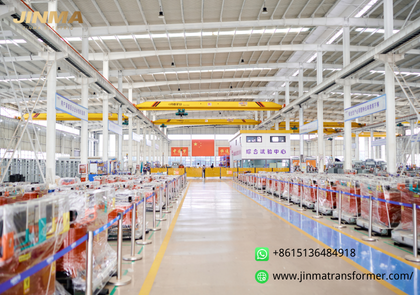
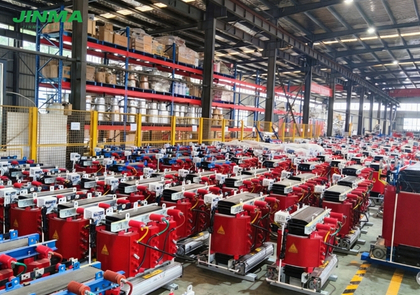
Power pole transformer belongs to long-cycle operation equipment, service life of more than 30 years, the quality of the manufacturer directly determines the equipment failure rate, power supply stability and full-cycle use cost, do not simply compare prices.
1 Verify industry standards compliance
Regular products must meet the corresponding industry standards, and the North American market must meet IEEE C57.12.20, ANSI, DOE energy efficiency, and NEMA standards; the international market is suitable for IEC 60076 series standards.
At the same time need to have UL, CSA safety certification, ISO9001 quality system certification, ISO14001 environmental system certification, can provide a complete type test report.
2 Evaluation of transformer factory experience and project case
Priority is given to pole mounted transformer manufacturers that focus on the research and development and production of distribution transformers, rather than general power equipment manufacturers, to ensure that the products are optimized for outdoor pole working conditions.
Focus on checking the landing cases of transformer manufacturers in special working conditions such as high temperature, high humidity, coastal salt spray, strong lightning strike, etc., and give priority to brands with large-scale power grid and cooperation experience in government-enterprise projects.
3 Identification of raw materials and process quality
The high-quality pole-mounted transformer adopts high-grade oriented silicon steel sheet, high-purity copper winding, high-quality sealing gasket and insulating material, with low equipment loss, strong short-circuit resistance and good insulation stability.
The tank body adopts thickening anti-corrosion technology, which can adapt to long-term outdoor corrosion environment and effectively avoid problems such as rust and oil leakage, equipment aging and acceleration.
4 Testing capabilities and after-sales support
The reliable pole transformer manufacturer can carry out a full set of routine tests on each equipment, such as variable ratio, resistance, insulation, withstand voltage, loss, etc., and can provide complete factory test data and type test reports.
At the same time, it has a perfect after-sales system, providing clear quality assurance service, long-term parts supply, technical guidance, rapid response to failures and other supporting services.
5 Focus on full life cycle costs rather than unit prices.
Low-cost inferior equipment seems to have low procurement costs, but no-load loss, load loss is high, long-term operating energy consumption costs far exceed high-quality equipment, and high failure rate, high operation and maintenance costs.
Selection requires comprehensive consideration of equipment energy efficiency, service life, failure rate, after-sales cost, and priority is given to high-quality equipment with lower life cycle costs.
FAQ About Power Pole Transformer
Q1: What is the core role of the pole mounted transformer?
The core role is to transmit high-voltage power in the power grid, step-down for residents, commercial, agricultural equipment can be safely used low-voltage power supply, is the overhead distribution network to achieve power landing, to ensure the safety of the end of the core equipment.
Q2: What are the common capacity specifications for transformers on poles?
Single-phase pole transformer capacity: 5kVA, 10kVA, 25kVA, 50kVA, 75kVA, 100kVA, 167kVA; three-phase pole transformer capacity: 30kVA, 75kVA, 150kVA, 225kVA, 500kVA. Large capacity equipment above 300kVA shall be installed with platform.
Q3: How much can the power pole transformer reduce the voltage?
Civil single-phase output standard 120/240V; Commercial three-phase output 208Y/120V, 480Y/277V; International common operating conditions output 400/230V, which can be adapted to different regional electricity standards.
Q4: How long is the normal service life of the power pole transformer?
Standard installation, regular maintenance of the pole on the transformer, the normal service life of up to 25-40 years. The service life of equipment under harsh working conditions, long-term overload and lack of maintenance will be shortened to less than 20 years.
Q5: Does pole-mounted distribution transformers support customization?
Support personalized customization of pole-mounted distribution transformers, which can adjust high and low voltage specifications, voltage regulation range, winding material, oil type, anti-corrosion coating, protection configuration, etc. according to project requirements to meet the use requirements of special working conditions.
Conclusion
Power pole transformer is an indispensable core equipment of overhead power distribution system. With the advantages of high cost performance, easy installation and strong adaptability, it is widely used in urban and rural civil, agricultural, commercial, infrastructure and other scenarios.
If you have need of power pole transformer selection, scheme customization, engineering quotation, technical parameter adaptation and other requirements, you can consult at any time. Jinma Electric will combine the project conditions to provide you with accurate capacity ratio, parameter customization, and a complete set of power distribution solutions.